Friday, January 9, 2015

Jesus Gives Life To The Full

January 9, 2015
Friday after Epiphany Sunday
  Click here for the complete text of today’s readings


Jesus Gives Life To The Full
Whoever possesses the Son has life;
whoever does not possess the Son of God does not have life.

Everyone wants a “full life,” fulfillment,” to live “life to the full.”

And this is what Jesus came to give: “I came that they may have life, and have it to the full” (John 10:10).

But we may not define a full life or fulfillment the way Jesus does. For Jesus, a full life means divine life: the Life of God; the Life that the Father, Son and Spirit have been living for all eternity. This is the life Jesus has in himself and shares with us by uniting us to himself as his body:

Do not work for the food that perishes, but for the food that endures for eternal life, which the Son of Man will give you… I am the way, and the truth, and the life. No one comes to the Father except through me… Just as the Father raises the dead and gives them life, so also the Son gives life to whomever he wishes… Very truly, I tell you, anyone who hears my word and believes him who sent me has eternal life, and does not come under judgment, but has passed from death to life… For just as the Father has life in himself, so he has granted the Son also to have life in himself… This is indeed the will of my Father, that all who see the Son and believe in him may have eternal life; and I will raise them up on the last day… And this is eternal life, that they may know you, the only true God, and Jesus Christ whom you have sent.” (John 6:27; 14:6; 5:21; 6:40; 17:3).

Many of us grew up confusing “eternal life” with “everlasting life,” life that just continues after death. We were taught that if we followed Jesus, we would spend it in “heaven,” being “perfectly happy.” If not, we would spend it in “hell,” being perfectly miserable. Heaven and hell were the “carrot and stick” to get us to lead a good life.

Our teachers described the stick in terrifying detail, but said practically nothing about the carrot. As a result, the older generation understood “heaven” mostly as just the alternative to hell. And when people stopped being afraid of going to hell—through a different but equally unexamined cultural conditioning—the prospect of “eternal life” with Jesus was too vague to keep them going to church.

Presumably, life with Jesus and the rest of the “saved” in heaven would be like interacting with  God in church. They found that a bore, so the present generation just focus on living as good a life as they can here and now, and settle for hoping for the best when they die.

They have no idea that the “eternal life” they will live in heaven begins already on earth. Or that, if they don’t experience it on earth, they may not experience it in heaven either.

Few people today are wrapped up in living “divine life,” or the “supernatural life” of “grace.” And if they are not trying to live a “supernatural” life, why do they need the “supernatural” helps offered by the Church? They find that what helps them most to live a good human life is having good human experiences. And they find very few of those in church. So they don’t go.

There are plenty of people out there who have no conscious relationship with Christ, do not attend any church, and who are perceived as living “good Christian lives,” although they could not tell you the difference between the New Law and the Old Law, or the Sermon on the Mount and the Ten Commandments. But their lifestyle is basically indistinguishable from that of the churchgoers, which means the churchgoers don’t know the difference either.

More than we like to  admit, believers and non-believers, the church-affiliated and the “nones,” are all just trying to live good, human lives. Few of them know what “divine life” is. And we aren’t teaching it.

If people have not experienced “eternal life”—here and now, on this earth—they don’t have a clue what Jesus really came to give. They don’t understand what John is talking about when he says:

We declare to you what was from the beginning, what we have heard, what we have seen with our eyes, what we have looked at and touched with our hands, concerning the word of life. This life was revealed, and we have seen it and testify to it, and declare to you the eternal life that was with the Father and was revealed to us. We declare to you what we have seen and heard so that you also may have fellowship with us; and truly our fellowship is with the Father and with his Son Jesus Christ (1John 1:1).

That kind of fellowship requires awareness of living on the level of God. It is a relationship based on the conscious experience of interacting with God and others in ways inspired by divine faith, sustained by divine hope and expressed in acts of divine love.  That is interaction empowered by “grace”—that is, by the favor of sharing in God’s own divine life, “eternal life.”

When John wrote, it was “to you who believe in the name of the Son of God.” And his purpose was “so that you may know that you have eternal life” (1John 5:13). Not “everlasting life,” a human life that lasts forever, but “eternal” life, life without beginning or end, the Life that belongs to God alone. When we enter into this Life we experience ourselves living on the level of God. That, and that alone, is “life to the full.” That is the life Jesus came to give.

It is a mystical experience. Until we have it, we don’t know Jesus Christ.

We know that the Son of God has come and has given us understanding so that we may know him who is true. And we are in him who is true, in his Son Jesus Christ. He is the true God and eternal life (1John 5:20).


Pray: “Father, reveal your Son to my mind and heart.”

Practice: In everything you do, ask how Jesus is doing it with you, in you and through you.


Discuss: How do you experience your life as divine?

Thursday, January 8, 2015

Jesus Redefines Success

January 8, 2015
Thursday after Epiphany Sunday
 Click here for the complete text of today’s readings. 

Jesus Redefines Success
Whoever is begotten by God conquers the world.

Jesus died a failure. In Nazareth he claimed:

The Spirit of the Lord is upon me,
because he has anointed me to bring glad tidings to the poor.
He has sent me to proclaim liberty to captives
and recovery of sight to the blind,
to let the oppressed go free.

“Today,” he said, “this Scripture passage is fulfilled in your hearing.”

But on the day he died, nothing had changed in Israel. No prisoners were liberated; the oppressed were still oppressed; blind people were still blind; and the “glad tidings” brought to the poor were not the tidings they hoped for.

Jesus failed to convert all but a handful of the people he preached to. They turned out enthusiastically to see “signs and miracles,” but turned away predictably when he called for faith and sacrifice. He wept over Jerusalem’s lack of response, couldn’t convert Capernaum, and was rejected in his home town by the people he grew up with. Even his hand-picked disciples abandoned him at the end (Luke 4:28; Matthew 11:23; 23:37; 26:56). When he gave up his spirit on the cross, he died defeated. And re-defined victory.

Jesus won by losing. And he still wins by losing in the members of his body continuing his messianic mission on earth. For Christians it is a profession of faith to say, “It isn’t whether you won or lost but how you played the game.” For Christians, victory is to live and die by faith, hope and love, regardless of any identifiable results. This is a profound liberation.

Jesus freed us from the need to “succeed.” He made wealth and prestige less than irrelevant; they are positive handicaps. All three synoptic Gospels repeat Jesus’ warning: “It is easier for a camel to go through the eye of a needle than for someone who is rich to enter the kingdom of God” (Matthew 19:24; Mark 10:25; Luke 18:25). St. Ignatius taught (Spiritual Exercises 142) that the devil’s strategy is to tempt people to work for two things that are not sinful—affluence and prestige—in order to make them vulnerable to the great sin, which is pride. And experience bears out Lord Acton’s observation to Bishop Mandell Creighton in 1887: “All power tends to corrupt.”

For Christians, the rich, the famous and the powerful are to be pitied. We should help them with compassion and love to make something of their lives in spite of their disadvantage.

Those who accept the priorities of Jesus have no fear of failure, because of ourselves there is nothing we can accomplish. Nothing we can do has any eternal value unless Jesus is doing it with us, in us and through us. Our fundamental belief, the most basic truth of our Baptism, is “It is no longer I who live, but it is Christ who lives in me” (Galatians 2:20). For Christians, the key to success is surrender.

For us, success doesn’t depend on power, but on a promise: “You did not choose me but I chose you. And I appointed you to go and bear fruit, fruit that will last” (John 15:16).

We can only fail if we choose to. We cannot fail for lack of looks, ability, talent, education, resources, favorable circumstances, luck, or helpful contacts. All results that depend on anything except our own free choice are irrelevant to personal success or failure. We can only fail by refusing to act out of faith, hope or love.

And these are free gifts of God. To these gifts above all, the promise of Jesus applies, “Ask and you will receive, so that your joy may be complete” (John 16:24). There is no reason, ever, for a Christian not to live in joy. It was on the very evening before his passion and death that Jesus said to his disciples, “If you keep my commandments, you will abide in my love, just as I have kept my Father’s commandments and abide in his love. I have said these things to you so that my joy may be in you, and that your joy may be complete” (John 15:10).

Jesus died a “loser” to give a new definition to “winner.” Jesus repeats six times in the Gospels: “Those who want to save their life will lose it, and those who lose their life for my sake will find it” (Matthew 10:39; 16:25; Mark 8:35; Luke 9:24; 17:33; John 12:25).

This gives new meaning, new confidence, new joy in life to all who accept to live on his terms.

“The victory that conquers the world is our faith.”
  
Pray all day:  
“Lord, do this with me, do this in me, do this through me!”

Practice: 
Never use the words “win,” “lose,” “success,” or “failure” in the same way again.


Discuss: 
Does this give you a new attitude toward the “successes” and “failures” in your life?

Wednesday, January 7, 2015

Jesus Makes Us Trinity

January 7, 2015
Wednesday after Epiphany Sunday
Click here for the complete text of today’s readings. 


Jesus Makes Us Trinity
In the Name of the Father,
and of the Son,
and of the Holy Spirit.

According to John, “No one has ever seen God.” But we have seen, and we “testify that the Father sent his Son as Savior of the world.”

How do we experience his salvation?

“In him was life.” John identifies the Life Jesus gives with Light: 

“The life was the light of all people… To all who received [his light], who believed in his name, he gave power to become children of God… And this is eternal life, that they may know you, the only true God, and Jesus Christ whom you have sent” (John 1:4,12; 17:3).

Jesus gives us life by giving us light to know God. The life he gives is God’s life. But God is love. So to know by the light Jesus gives is to live and love like God.

These three go together. Like the Three Persons of the Trinity, they are inseparable: divine Life from the Father as source of all being and goodness; divine Light from the Son as Word, expression of truth; divine Love from the Holy Spirit as experience of oneness.

Like the life of the triune God that we share, the “grace of the Lord Jesus Christ” is a triune gift: we live through the gift of knowing; we know through the gift of living; and both are verified in the gift of loving.

In practice, this means that if we “love one another as Jesus has loved us” (John 13:34), we know Jesus is giving us light and life.

The Good News is “to know and to believe in the love God has for us” by experiencing that love being given to others in us, through us and by us acting in union with Jesus.

What do we get out of believing in Jesus? If we put the phrases of the first reading (1John 4:11-18) in logical order, John gives us ten reasons to be Christians:

If we acknowledge that Jesus is the Son of God:
      God remains in us and we in God
      as God is, so are we in this world
      God gives us of his Spirit
      we know that we remain in him and he in us
      we know and we believe in the love God has for us
      we remain in love
      we love one another
      his love is brought to perfection in us
      we have no fear, because there is no fear in love
      we have confidence on the day of judgment.

The Christian life is all about being, knowing and loving. And giving expression to truth and love in action. Basically, it is living the Life of the Trinity as Father, Word and Spirit. On earth and in heaven. Now and forever.


Pray and Practice: 
When you make the “Sign of the Cross,” ask the Father for 
Life, the Son for Truth, and the Spirit for Love.


Discuss: How have you experienced, knowing, loving, and living on the level of God?

Tuesday, January 6, 2015

Jesus Gives Knowledge and Love

January 6, 2015
Tuesday after Epiphany Sunday
Click here for the complete text of today’s readings. 


Jesus Gives Knowledge and Love
Everyone who loves is begotten by God and knows God.

With logical consistency we can rearrange John’s words to read: “Everyone who is begotten by God knows and loves.”

Knowledge and love: the fruit of embracing our Baptism. These are two gifts Jesus gives. We need to recognize this and appreciate it.

Parenthesis: We will do both if we praise and thank him for these gifts, as Jesus did the Father: “Jesus rejoiced in the Holy Spirit and said, ‘I thank you, Father, Lord of heaven and earth, because you have hidden these things from the wise and the intelligent and have revealed them to infants’” (Luke10:21). It is a principle of life that what we praise we will appreciate. What we don’t praise we will not appreciate. Those most likely to leave the Church (or not be truly in it) are those who don’t show any enthusiasm during the Gloria at Mass.

Jesus “saves” us by teaching us truth. John identifies him as the “Word” (logos, intelligibility) of God who gives life by giving light: “In the beginning was the Word… In him was life, and the life was the light of all people.” When many of his disciples “turned back and no longer went about with him,” Peter’s reason for staying was: “Lord, to whom can we go? You have the words of eternal life.”

Jesus’ words are not just words. The early Christians called his teaching “the word of life.” Jesus said, “The words that I have spoken to you are spirit and life… If you continue in my word, you will know the truth, and the truth will make you free.”

Jesus saves us from life-destroying ignorance. Because of blind enslavement to the attitudes and values of our culture, we “sit in darkness and in the shadow of death.” But Jesus came to free us, to “guide our feet into the way of peace.” His light “shines in the darkness, and the darkness did not overcome it” (John 1:1; 6:64, 68; 8:31; Luke 1:79; Philippians 2:16; 1John 1:1).

Only Jesus overcomes the darkness that deludes every human mind and culture.

The Jewish Scriptures, also called the “Old Testament,” are the revealed word of God himself. But they are incomplete. Hebrews (1:1) says:

Long ago God spoke to our ancestors in many and various ways by the prophets, but in these last days he has spoken to us by a Son… He is the reflection of God’s glory and the exact imprint of God’s very being, and he sustains all things by his powerful word.

There is only one pure and complete source of truth for our day: Jesus Christ, the Word of God made flesh. Those who do not know Jesus must take what they find in the Jewish Scriptures, then for the rest pick and choose among the partial and uncertain theories of groping human beings. But those who know Jesus can find in his words the light they need to live by, in his example the life that embodies his words, and in the Church his words made flesh in our time. Jesus is “the way, and the truth, and the life—the same: yesterday, today and forever” (John 14:6; Hebrews 13:8).

Blessed is he who comes in the name of the Lord.
Justice shall flower in his days,
and profound peace, till the moon be no more.
The Lord is God and has given us light.

Jesus has empowered us to know and to love.

Pray: 
“Lord, with you is the fountain of life; in your light let me see light!” (Psalm 36)

Practice: 
Keep a Bible on your pillow. Read one line every night.


Discuss: 
What have you learned from Jesus that has helped you to love?

Monday, January 5, 2015

Jesus Has a Voice: Ours

January 5, 2015
Monday after Epiphany Sunday
Feast of Saint John Neumann, Bishop


Jesus Has a Voice: Ours
Every spirit that acknowledges Jesus Christ come in the flesh belongs to God.

How does Jesus save our minds from veering off into distortion?

Centuries of cultural conditioning, in cultures infected by billions of “original” and not-so-original sins, have embedded more distortions than we can recognize in the perceptions, attitudes and values of the human race. No one escapes.

When one culture replaces another, whether in time or in space, some misconceptions may be purified out, but others will be implanted. There is no such thing as a “pure” human society, including the society of “cultural Catholics.”

The bishops who assembled for the Second Vatican Council in 1962 acknowledged this.

For although the Catholic Church has been endowed with all divinely revealed truth and with all means of grace, yet its members fail to live by them with all the fervor that they should, so that the radiance of the Church's image is less clear… and the growth of God's kingdom is delayed. All Catholics must therefore aim at Christian perfection and, each according to their station, play their part so that the Church may daily be more purified and renewed. For the Church must bear in her own body the humility and dying of Jesus, against the day when Christ will present her to Himself in all her glory without spot or wrinkle (Decree on Ecumenism 9).

We urge all concerned, if any abuses, excesses or defects have crept in here or there, to do what is in their power to remove or correct them, and to restore all things to a fuller praise of Christ and of God (The Church 51).

The message here is not, “Don’t trust the Church.” The message is, “You are the Church. Make the Church trustworthy by paying attention to your spiritual instincts.”

You aren’t always right either. But Jesus, through his Spirit, is trying to guide you. Until you hear and recognize his voice, question every other.

My sheep follow me because they know my voice. They will not follow a stranger... I am the good shepherd. I know my own and my own know me, just as the Father knows me and I know the Father (John 10:1).

It’s all about personal relationship. Communication with God is always personal. The Father, Son and Spirit only communicate with you Person-to-person, by enlightening your mind and moving your heart. Only in your own mind can you recognize God’s truth. Only in your own heart can you feel God’s Spirit.

So whatever you read, whatever you hear, test to see if the Spirit is verifying in your heart what the words seem to say. If not, read more. Ask questions. Reflect. Discuss with others. Pray.

Jesus is still teaching in the flesh. He is in the world, speaking in the actual circumstances of our time and space. He is speaking in and through the Church. Those who hear the Church hear Christ. And we are the Church. The Church is us.

Jesus said to the seventy disciples he sent out on mission: “Whoever listens to you listens to me, and whoever rejects you rejects me, and whoever rejects me rejects the one who sent me” (Luke 9:16). He said this to all seventy of them. They were all lay persons.

Pope Francis clarifies this:

“No manifestation of Christ, even the most mystical, can ever be detached from the flesh and blood of the Church, from the historical concreteness of the Body of Christ… Our faith is not an abstract doctrine or philosophy, but a vital and full relationship with a person: Jesus Christ.. Where can we encounter him? We encounter him in the Church. Without the Church, Jesus Christ ends up as just an idea, a moral teaching, a feeling. Without the Church, our relationship with Christ would be at the mercy of our imagination, our interpretations, our moods.” (New Year’s Day homily, January 1, 2015).

By the “Church” Francis does not mean the hierarchy:

The Church is the people of God on the journey through history, with joys and sorrows. Thinking with the Church, therefore, is my way of being a part of this people. And all the faithful, considered as a whole, are infallible in matters of belief, and the people display this infallibilitas in credendo, this infallibility in believing, through a supernatural sense of the faith of all the people walking together. This is what I understand today as the ‘thinking with the Church’ of which St. Ignatius speaks. When the dialogue among the people and the bishops and the pope goes down this road and is genuine, then it is assisted by the Holy Spirit… We should not even think, therefore, that ‘thinking with the Church’ means only thinking with the hierarchy of the Church (America Magazine interview, September 30, 2013).

We don’t know what Catholic doctrine is until we know it is “catholic”—kataholos: held “throughout the whole,” universal, worldwide. And the first way we know this is by the effect a teaching has on an ordinary good person or congregation. St. Ignatius teaches:

In the case of those who are going from good to better, the good spirit touches the soul gently, lightly, and sweetly, like a drop of water going into a sponge. The evil spirit touches it sharply, with noise and disturbance, like a drop of water falling onto a stone. But in those going from bad to worse, the effect is reversed. It depends on the disposition of the soul: contrary spirits enter with noticeable noise and disturbance; similar spirits enter quietly, as if going into their own house by an open door. (Spiritual Exercises, rules for the discernment of spirits 335).

So Catholics culturally conditioned to accept false teachings—such as racism, “profit only” economics, or those attitudes identified in the first session of Vatican II as “legalism, clericalism, and triumphalism”—will be disturbed by true “prophets.” But when preaching or teaching disturbs good Catholics’ sense of justice and compassion, or makes them feel alienated from God, it is probably the voice of false prophets, not the voice of the Good Shepherd they are hearing.

Bottom line: Jesus is still speaking on earth. In the flesh. With a human voice. But we have to learn to discern it.

We begin by listening to our hearts.

Pray: 
“If today you hear his voice, harden not your heart!”

Practice: 
Pay attention to your feelings. Pray over anything that turns you on or turns you off.


Discuss: 
What have you heard from the pulpit that you felt was or was not God’s voice?

Sunday, January 4, 2015

Jesus Gives Meaning Through Hope

January 4, 2015
Feast of the Epiphany of the Lord
Click here for the complete text of today’s readings.


 Jesus Gives Meaning Through Hope
See, darkness covers the earth, but upon you the Lord shines.

The world is basically beautiful, and so are people. Acts of love and heroism are taking place every day. There is also unending war, poverty, worldwide exploitation of the powerless, violent crime, terrorism, drug abuse, inhuman caging of criminals, neglect of the elderly and sick, and millions of children growing up in slums.

Psalm 90 says that, even for believers, “The days of our life are seventy years, or perhaps eighty, if we are strong; even then their span is only toil and trouble; they are soon gone, and our years come to an end like a sigh.” Taking in the whole picture of life on this earth, aren’t we sometimes tempted to ask, “Is this all there is?”

Christians are the “stewards” of a great hope. Everyone who knows Jesus Christ says to the world with Saint Paul: “The stewardship of God’s grace was given to me for your benefit… the mystery that was made known to me by revelation.” And what is this mystery?

It is that all human beings, of every race and nation, are invited to be “coheirs, members of the same body, and copartners in the promise in Christ Jesus.” And sharers in his victory.

Christians are those who always see the present in the light of a promised future. This is not the “pie in the sky when you die” promise of individual bliss for those who “make it to heaven.” It is the realization of God’s “plan for the fullness of time, to gather up all things in Christ, things in heaven and things on earth” (Ephesians 1:10).

On the last Sunday of the year, the feast of Christ the King, we profess to the Father our faith in his promise:

For you anointed your Only Begotten Son,
our Lord Jesus Christ, with the oil of gladness
as eternal Priest and King of all creation,
so that, by offering himself on the altar of the Cross
as a spotless sacrifice to bring us peace,
he might accomplish the mysteries of human redemption
and, making all created things subject to his rule,
he might present to the immensity of your majesty
an eternal and universal kingdom,
a kingdom of truth and life,
a kingdom of holiness and grace,
a kingdom of justice, love and peace.

In every Mass, before receiving Communion, we pray with “great expectation”: “Deliver us, Lord, from every evil… We are awaiting the blessed hope and the manifestation of the glory of our great God and Savior, Jesus Christ” (see Titus 2:13).

In the Greek text the word “manifestation” (wrongly translated as “coming” in the liturgy) is epiphaneian—epiphany. We celebrate the feast of the Epiphany as the day when Jesus was “manifested” to “magi from the east” as a preview of Isaiah’s promise: “all from Sheba shall come bearing gold and frankincense, and proclaiming the praises of the Lord.” We celebrate the Epiphany once a year, but we remind ourselves in every Mass of the final and eternal epiphany, the manifestation of Jesus in all his glory that is our “blessed hope.”

We do this to keep ourselves aware that the present is only a prologue to the future.

What does Jesus give to those who believe in him? The answer is “hope and stewardship.”

Because of Jesus (and only because of him, as history has proven again and again), we have hope in a future that will vindicate everything in the present—prove that God’s providence was “right, reasonable, and justified”—and give ultimate meaning and value to human life on earth.

Our own individual lives have ultimate meaning and value because we have been given and called to stewardship (oikonomian). “In Christ,” as baptized into his kingship, we are commissioned to be “managers,” “administrators of the manifold grace of God,” and to “serve one another with whatever gift each of us has received” (1Peter 4:10). Jesus himself said it: “You did not choose me but I chose you. And I appointed you to go and bear fruit, fruit that will last” (John 15:16). This gives meaning and purpose to ever moment of our lives.

Only Jesus can save the world from darkness and death. Only Jesus can keep life on earth from veering off into distortion and destructiveness, mediocrity and meaninglessness. But Jesus will only do it through us, acting in and through our human weakness. By Baptism we “became Christ.” We are his body on earth. That is our burden and our glory, our crucifixion and our joy, our dying that gives life to the world.

Stewardship gives meaning to our lives. Hope gives power to our stewardship. We have both stewardship and hope because Jesus is acting with us, in us and through us.

“Darkness covers the earth.” But we live in light, “awaiting the blessed hope and the epiphany of the glory of our great God and Savior, Jesus Christ.”


Pray: “Come, Lord Jesus!”

Practice: Live in the present, looking to the future.


Discuss: What gives long term meaning to your life?

Saturday, January 3, 2015

Jesus Saves Our Lives On This Earth

January 3, 2015
Feast of The Most Holy Name of Jesus
Click here for the complete text of today’s readings.


Jesus Saves Our Lives On This Earth

All the ends of the earth have seen the saving power of God.

I think my personal relationship with Jesus began when I experienced his acceptance of me. But I don’t want to downplay what I would call my less personal, more “professional” relationship with him as Savior. That was my first relationship, the first reason I had for interacting with him, and it is still a major reason why interacting with Jesus should be a part of everyone’s life. The name “Jesus” means “God saves.”

We may laugh at Baptists buttonholing everyone and asking, “Are you saved?” But it is still a fundamental (and not just a fundamentalist) question for human life. Consider the alternative.

For fundamentalists the alternatives are heaven or hell. Jesus “saves” us from going to hell. If people don’t feel concerned about hell today, it is simply because they are programmed by contemporary culture to dismiss it—just as blindly as the previous generation was programmed to take for granted the menace of “fire and brimstone” as unquestioningly as everyone else did in their day. But truth is not time-specific. It is just as stupid—perhaps more so—to ignore the possibility of eternal damnation now as it was to be obsessed with it as a looming probability sixty years ago.

But we don’t need to speculate about life after death in order to see the need for a Savior. What is perfectly obvious to anyone who mixes in society or listens to the news is that human life on this earth is in constant danger of veering off —to destructiveness and distortion, mediocrity and meaninglessness. In every one of us. We see it happening all around us. We have all experienced it happening to ourselves in various ways. You don’t have to be “religious” to see there is darkness in this world or to feel the shadow of death.

And what will save us from it?

Only the young and the invincibly arrogant are naïve enough to think they can save themselves. Most of us, by the time we reach adulthood, have seen friends and watched ourselves being sucked in by distorted attitudes and seduced by destructive ways of behaving. We have experienced mediocrity and questioned the meaning of our lives. No one is immune.

If we reflect more deeply, we realize that salvation must come from outside the created universe. No movement generated by any human culture within this world can be free of the seeds of corruption that infect every human society. False messiahs and self-constituted saviors are constantly arising. The doppelgängers of Stalin, Hitler, Mussolini and Mao Tse-tung keep reappearing all over the world. And we never learn. We keep rallying to their banners.

When the demons of force and violence who possessed the Nazis were discredited by the defeat and disillusionment they themselves had brought about, they simply moved into the Zionists with the same seductive promise of conquering a homeland. And the same-old same-old repeated itself. The identical demons crossed over into Islam to impel Muslims into a “Holy War” to defeat the Jews and their allies. Then they possessed fanatics to flock to the Taliban and to the ISIS as they had possessed the Nazi Brownshirts, the Fascist Blackshirts and the red-scarfed Communist Pioneers. They drove President George W. Bush to invade and wreck Iraq in the name of deliverance and to approve torture of prisoners for the sake of homeland security.  The demons of force and violence are the same, no matter whom they possess. They don every uniform and fight under every flag, doing the same thing no matter what side they are on.

In answer to this age-old dominance of evil Peter proclaimed Jesus of Nazareth as “the stone that was rejected by the builders and has become the cornerstone.”

“There is salvation in no one else, for there is no other name under heaven given among mortals by which we must be saved” (Acts 4:11).

For you alone are the Holy One,
you alone are the Lord,
you alone are the Most High,
Jesus Christ,
with the Holy Spirit,
in the glory of God the Father.
Amen.

On this day we celebrate Jesus—“God saves”—who alone can keep our lives from veering off to distortion and destructiveness, mediocrity and meaninglessness. If we involve him in everything we do.


Pray: “Jesus save me. Act with me, in me and through me in everything I do.”

Practice: Interact with Jesus all day long. Involve him in everything you do.


Discuss: What do you need to be saved from? Are you using Jesus for it?

Friday, January 2, 2015

Relationship With Jesus Expands Our Mind

January 2, 2015
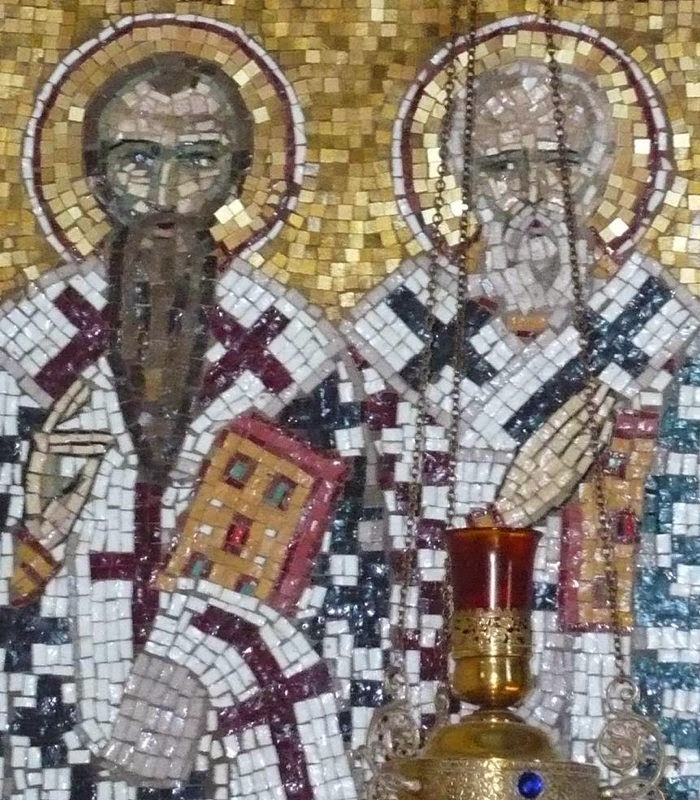
Feast of Saints Basil the Great and Gregory Nazianzen, 
Bishops, Doctors of the Church


If what you heard from the beginning remains in you,
then you will remain in the Son and in the Father.

One of the things we get out of relationship with Jesus is the ability to read the “doctors of the Church” and know what they are talking about. When we share their faith, we “speak their language.” Like knowing English lets us read Shakespeare, or speaking Spanish lets us experience another culture.

“Doctor of the Church” is a title given to someone who has made a special contribution to theology or spirituality. We have to understand Christianity to appreciate the doctors of the Church. And reading the doctors of the Church helps us appreciate Christianity.

As Christianity helps us appreciate life.

As of 2012, the Catholic Church had named 35 Doctors of the Church: 27 from the West and 8 from the East; 4 women; 18 bishops, 12 priests, 1 deacon, 3 nuns, 1 consecrated virgin; 26 from Europe, 3 from Africa, 6 from Asia.

Just some samples from St. Basil the Great (c. 330 - January 1, 379):

“When you sit down to eat, pray. When you eat bread, do so thanking Him for being so generous to you. If you drink wine, be mindful of Him who has given it to you for your pleasure and as a relief in sickness. When you dress, thank Him for His kindness in providing you with clothes. When you look at the sky and the beauty of the stars, throw yourself at God’s feet and adore Him who in His wisdom has arranged things in this way. Similarly, when the sun goes down and when it rises, when you are asleep or awake, give thanks to God, who created and arranged all things for your benefit, to have you know, love and praise their Creator.”

“The power of prayer should be expressed in the moral attitude of our soul and in the virtuous actions that extend throughout our life…  This is how you pray continually — not by offering prayer in words, but by joining yourself to God through your whole way of life, so that your life becomes one continuous and uninterrupted prayer.”

 “A psalm imparts serenity of soul; it is the author of peace, which calms bewildering and seething thoughts… A psalm forms friendships, unites those separated, conciliates those at enmity. How, indeed, can we still consider as enemies those with whom we have uttered the same prayer to God?

“If you see your neighbor in sin, don’t look only at that, but also think about what your neighbor has done or does that is good, and sometimes you will find that your neighbor is better than you.”

“When someone steals another's clothes, we call them a thief. Should we not give the same name to one who could clothe the naked and does not? The bread in your cupboard belongs to the hungry; the coat unused in your closet belongs to the one who needs it; the shoes rotting in your closet belong to the one who has no shoes; the money which you hoard up belongs to the poor.” (See http://orthodoxchurchquotes.com/category/sayings-from-saints-elders-and-fathers/st-basil-the-great).

If we want to let Jesus act with us and in us and through us, reading the doctors of the Church will help us think with his thoughts, and speak with his words, and act as his body on earth.

Pray: 
“Come, Holy Spirit! Fill the hearts of your faithful. 
Renew the face of the earth!”

Practice: 
Enter into your inheritance. 
“Draw out of your treasure what is new and what is old” (Matthew 13:52).


Discuss: 
Do you feel that being Christian has given you something 
like a “library of relationships” with great people?

Thursday, January 1, 2015

Starting Right

January 1, 2015
Solemnity of Mary, Mother of God
Click here for the complete text of today’s readings.


God sent the Spirit of his Son into our hearts, crying out, “Abba, Father!”

Catholics begin the New Year celebrating motherhood with the feast of "Mary, Mother of God." Motherhood means life. But for us life means sharing in divine Life. So we celebrate the Mother of God—as Jesus’ Mother and ours.

Mary didn't raise her boy just to be a good human being. And our parents didn't raise us that way either, if we grew up Christian. We were taught from the beginning that, because of our Baptism, God is our Father. Because of our Baptism, we live by the life of his Son, Jesus Christ, who took our bodies to be his own, to live and act and continue his mission with us, in us and through us. Because of our Baptism, the Holy Spirit was poured out into our hearts, so that we might “live by the Spirit” and “be guided by the Spirit” in everything we do (Galatians 5:25).

Our prayer to begin the New Year is the prayer with which we begin every Mass: “May the grace of the Lord Jesus Christ (the favor of sharing in the divine life of God) be with you!” If we claimed the freedom to express our faith openly, this is the way we would meet and part from every Christian we live and work with. And in the silence of our hearts, this should be our prayer for every “non-” and “none” we meet also, unless they would welcome our saying it out loud.

We might say “Goodbye” without abbreviating it: “God be with you.”

Every Jew, every Muslim, and every other recipient of the Scriptures that are “the gift of the Jews” will welcome the blessing God taught through Moses:

The Lord bless you and keep you!
The Lord let his face shine upon you, and be gracious to you!
The Lord look upon you kindly and give you peace!

What the blessing says is that the Lord alone—not luck or circumstances—can make the New Year happy. This is doubly obvious to Christians, who understand that the only “full life” is divine life, which depends on God acting with us and in us and through us in everything we do: “The Lord bless… the Lord keep… the Lord be… the Lord look… the Lord give….”What the New Year is all about is the Lord acting with us, in us, through us and for us in everything we do.

We begin the New Year saying with Paul: “It is no longer I who live, but it is Christ who lives in me” (Galatians 2:20).

May the grace of the Lord Jesus Christ,
And the love of the Father,
And communion in the Holy Spirit
Be with you.


Pray and Practice: Form the habit of saying the WIT prayer—“Lord, do this with me, do this in me, do this through me”—all day, every day, all year long.


Discuss: Has this reflection given you a new attitude toward the New Year?